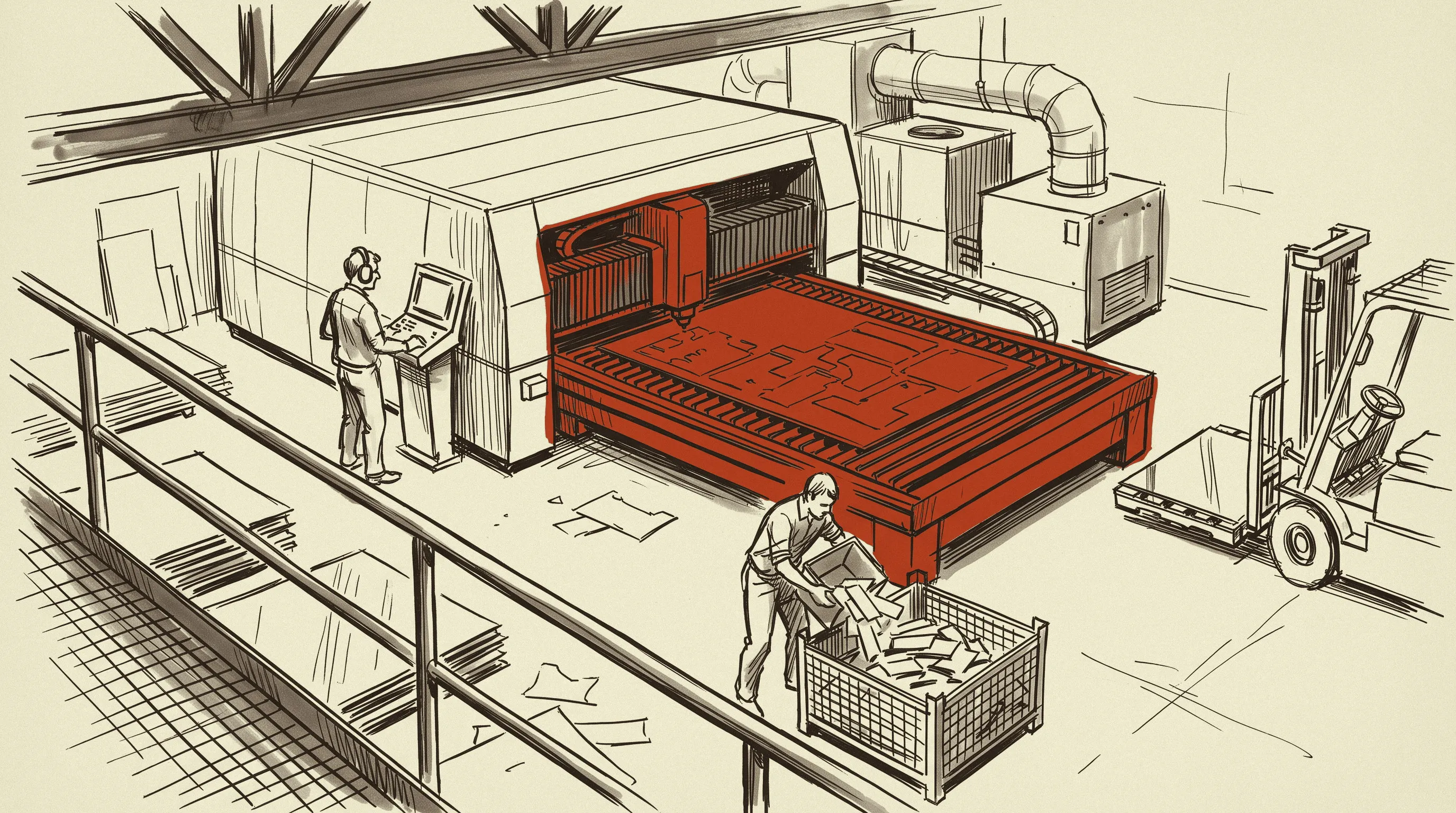
A Chinese exporter’s own price guide puts a fully enclosed 6 to 12 kW fiber laser with an exchange table at $45,000 to $85,000 FOB, hardware only, as of December 2025. Federal Prison Industries paid $645,000 to Trumpf’s Pennsylvania dealer for one fiber laser cutting machine in July 2025, and two Army depots paid $1,610,580 and $1,750,000 for theirs in the same quarter. Land the Chinese machine at the top of its band, pay the 41% duty stack, rig it, and it sits on the floor at about $128,000. The gap to the cheapest Western award is $504,000 on one machine, and this piece is about what that money buys. It is the first worked example for the Equipment Price Benchmark in this machine class, and every price in it is a guide, a listing, an award or a filing, dated, with whose number it is.
The ladder runs $45,000 to $85,000 for the exporter’s enclosed 6 to 12 kW band, $100,000 and up for Gweike’s 12 kW tier, $127,850 for our landed and dutied arithmetic, $185,000 for a Chinese-brand 12 kW at a US dealer, $299,900 for a 12 kW Otinus with a tube cutter, installed and trained, then $645,000, $1,233,175, $1,610,580 and $1,750,000 for the four federal awards. The piece covers where those prices come from, the 41% duty, the laser source both sides buy from the same three suppliers, the service and paper inside the Western price, a ten-year comparison with every assumption marked, what to do Monday, and behind the wall the PO checklist and the shortlist by buyer type.
Two Price Lists for One Machine Class
The Chinese price is public because the exporters publish it to win the quote. Arcus, a Jinan exporter, writes that a $30,000 FOB machine “will likely cost you $42,000 by the time it sits on your floor in Texas” and tells the buyer to ask for a DDP quote. The same page prices the exchange table at about $15,000, a 6025 bed at $15,000 over a 3015, and an IPG source at $5,000 to $15,000 over a Raycus, rising to about $20,000 on a 12 kW machine. Gweike’s guide puts 12 kW and up at $100,000 plus with no incoterm stated. STYLECNC lists its 1.5 to 6 kW 3015 at $19,500 to $31,000 with a one-year warranty on the entire machine, updated 28 September 2026. These are asking prices from the seller’s own page, not transactions, and they carry no n, which is the first thing Quote Check flags when a buyer pastes one in.
The Western price exists in public only where a public body bought one. We verified each award against the USAspending API on 11 October 2026. Letterkenny Army Depot paid $1,233,175 in August 2022 for a 12 kW fiber laser with dual shuttle tables of 242 by 80 inches, on one offer. The Marine Corps paid Cincinnati Incorporated $1,289,608 in May 2024 on eight offers. An award value includes delivery, installation, training and whatever automation the solicitation asked for, so it is a system price, not a list price, and the kilowatts behind the UNICOR and Tobyhanna numbers sit in attachments the public record does not show.
Neither side publishes a transaction price for a configured 12 kW machine with a dual shuttle, so the honest statement of the gap is a range: $504,000 against the lowest 2025 federal award and $1.1 million against the only 12 kW federal award on record. The lesson of What a Haas VF-2 Really Costs holds here with the sign reversed: in machining centers Haas publishes a list and nobody else does, and in sheet-metal lasers the Chinese builders publish and the Western builders do not, which is why Trumpf, Bystronic and Amada score where they do on the OEM Disclosure Scorecard and why the Public Bid-Tab Price Book has to go to federal awards for a Western number at all.

The 41% Duty Stack and What It Changes
A laser cutting machine for working metal enters under HTS 8456.11.10 at a column 1 rate of 3.5% in the 2026 schedule, Revision 21. The line sits on Section 301 List 1, which added 25% from 6 July 2018 under heading 9903.88.01 and was left at 25% by the September 2024 four-year review. The July 2026 Section 301 action on forced-labor enforcement added a further 12.5% on products of China under heading 9903.05.31 from 24 July 2026, per CBP CSMS 69326983. Those three instruments sum to 41% of customs value. The IEEPA tariffs on top of that died with Learning Resources v. Trump on 20 February 2026, and the 10% Section 122 surcharge that replaced them expired on 24 July 2026.
China pays 3.5 plus 25 plus 12.5 for 41%, Switzerland and Japan pay 12.5% all-in under the July notice’s cap, Germany and Italy pay 10% all-in, and a machine assembled in Farmington, Connecticut or Hoffman Estates, Illinois pays nothing. No 8456.11 line appears on any Section 232 metals annex, including the 407 derivative codes added in August 2025. The open item is the Section 232 investigation into robotics and industrial machinery, whose scope names “laser and water-cutting tools and machinery” and whose 270-day clock ran out in May 2026 with no proclamation in the Federal Register as of 11 October 2026. The September 2026 tariff schedule walks every machinery line through the same instruments, and the Factory Automation Roadmap tracks the docket.
On an $85,000 machine the stack is $34,850, which is real money and still only 7% of the gap to the cheapest Western award. Duty is assessed on customs value, the FOB invoice for a direct import. A Western machine built abroad pays its 10 or 12.5% on the OEM’s transfer price, inside the quoted number, and Bystronic’s US terms say so: “All applicable U.S. customs or duties, Installation, and Commissioning are included in the price”. Bystronic also wrote in its 2025 annual report that it advanced “the ramp-up of our facility in Hoffman Estates, USA” to deliver out of the United States and blunt the tariff, and Trumpf’s Farmington site has produced laser machinery, resonators and automation on about 400,000 square feet since before the current schedule. The question to put on the RFQ is the country of origin of the machine that will ship, not the address of the brand.
The Imports Did Not Slow Down
The trade data show how little the stack has slowed the flow. US imports of laser-operated machine tools under HS 845611 ran $587 million in 2025, with China at $66.5 million and 4,419 machines, Germany at $133.9 million and 2,162, Italy at $103.5 million, Japan at $106.3 million and Switzerland at $45.1 million, per Census figures republished by UN Comtrade. China’s first half of 2026 came to $40.7 million against $33.7 million in the first half of 2025, summed from the monthly series, through a February with IEEPA, a spring with Section 122 and a July with the new 301 rate.
China’s line reads $59.4 million in 2022, $65.9 million in 2023, $73.1 million in 2024 and $66.5 million in 2025, while Germany swings from $161.4 million in 2023 to $91.0 million in 2024 and back to $133.9 million. The heading covers every machine tool operated by a laser, marking machines included, so the unit counts overstate cutting machines and the averages below understate them.
Japan’s 431 machines averaged $246,737 of customs value in 2025, Italy’s 1,249 averaged $82,906, Switzerland’s 713 averaged $63,240, Germany’s 2,162 averaged $61,934 and China’s 4,419 averaged $15,057. The Lead-Time Monitor does not yet track laser cutters as a class, and this unit series is the first input when it does.
The Laser Source Is Not Where the Gap Is
Both sides of the gap buy the laser from one of three places: IPG in Oxford, Massachusetts, or a Chinese maker, or the OEM’s own disk or fiber plant. IPG’s 10-K for 2025 reports that high-power continuous-wave lasers, the cutting and welding sources, brought in $308.8 million, 30.8% of revenue, against $525.0 million and 40.8% in 2023, a 41% fall in two years. The 2024 10-K gave the reason in a sentence: “increased competition impacted sales in cutting”. The 2025 filing names Wuhan Raycus and Maxphotonics as competitors, warns that “market participants, particularly in China, have reduced and may continue to reduce, prices”, and says the Asian competitors “are beginning to export their fiber lasers and fiber laser-based systems to non-Asia markets.” IPG’s gross margin was 38.0% in 2025 and the company booked about 120 basis points of tariff cost in it.
The left panel reads $525 million, $333 million and $309 million for 2023 to 2025, and the right panel reads about 6,800 Raycus lasers of 10 kW and above in 2024, 8,561 in 2025, and more than 10,000 for Max Photonics in 2025. Raycus disclosed that it sold 186,000 lasers in 2025 and cut product cost by more than 20%, as reported by Securities Times from the annual report, and that its gross margin touched 2.88% in the fourth quarter of 2024 after a year in which it blamed the revenue miss on price declines, as reported by Jiemian. Max Photonics booked RMB 3.97 billion in 2025 and 28.6% of the Chinese fiber laser market, per the 2026 China Laser Industry Development Report as reported by Sina. nLIGHT, the other US source maker, saw its industrial revenue fall from $71.0 million in 2023 to $38.8 million in 2025 on lower unit sales of cutting lasers.
A 12 kW source from Raycus or Max is a commodity sold near cost, and the same exporters will fit an IPG for about $20,000 more, so the source explains at most $20,000 of a $504,000 gap. The exporter’s number comes from Arcus, and a UK reseller of Chinese machines puts the ratio at about £20,000 for a 6 kW Chinese source against £100,000 to £120,000 from IPG, a vendor blog with no date. What an IPG or a Trumpf disk source buys is a longer stated life and a wider warranty, not more kilowatts. IPG’s product page claims electrical efficiencies over 40% and operation “for over a decade”, and Bystronic’s terms offer sixty months of cover on the source and head under a premium plan. Bodor’s Iowa dealer offers five years on the source and head on a 12 kW machine with a Bodor-branded source, which is the Chinese side’s answer and worth exactly as much as the dealer’s balance sheet.
What the Western Price Contains
A federal award of $1.2 million for a 12 kW machine with dual shuttles is a system: machine, tables, delivery, installation, training and a dealer that answers the phone. The Chinese $85,000 is a crate at a Chinese port. Everything between the two is a line a buyer can price.
Installation and acceptance come first. Trumpf’s US terms say the machine is “subject to final acceptance testing after installation at the installation site”, run by the seller’s operator to the seller’s procedure plus any tests “specified in the purchase order”, with the machine deemed accepted at production use or three months after delivery, whichever comes first. The same document puts rigging and placement on the buyer and payment at 20% with the order, 70% before shipment and 10% net ten days after installation completion. Bystronic’s terms include installation and commissioning in the price and give the buyer three options at the end: accept, accept with conditions, or do neither and “authorize BYSTRONIC to immediately disable the Product from functioning until Buyer accepts”. The same terms state that production estimates “are not guaranteed or warranted”, the sentence to read twice before believing any vendor’s sheets-per-hour number.
Trumpf warrants one year from installation completion, Bystronic twelve months conditional on a ByCare service contract and sixty months on the source and head with premium cover, Mazak’s machine-tool terms give two years from start-up with a 45-day defect notice and liability capped at the purchase price, Bodor through its Iowa dealer offers five years on source and head and three on main parts with 50% down and 50% before shipment, HSG through a Milwaukee dealer offers three years on the machine and two on the source, and a direct STYLECNC import comes with one year. Amada America publishes no US terms we could find. Every Western document caps the seller’s liability at the price of the item and excludes consequential damages, so the warranty is the only downtime insurance in the contract, the point Liquidated Damages at 0.5% a Week made for switchgear.
Service is the second line, and it has a public rate. Hymson’s benchmark table puts a laser or 5-axis specialist at $250 to $400 an hour, an OEM distributor technician at $150 to $225, and travel at $1.50 to $2.00 a mile, and it puts annual maintenance at 2 to 5% of purchase price. The federal record shows what OEM service costs when a depot buys it as a contract: the Navy paid Trumpf $39,640 in August 2025 for preventive and corrective maintenance on a TruMatic laser system, and the Army paid Mazak Optonics $145,008 in October 2025 for laser preventive maintenance. An Air Force order for one Trumpf optical cutting head came to $18,600 in March 2022, the spare that decides whether a crash costs a day or a month, and the reason the recommended spares list belongs in the PO.
Nozzles, Nitrogen and Power
Consumables are the one line that does not separate the two machines, because a 12 kW head eats the same nozzles and windows whoever built the frame. Airgas sells a Bystronic-fit 1.5 mm brass double nozzle at $8.10 each, a Hypertherm ten-pack for the same machine lists at $45.55, and Laguna’s D32 nozzles for Chinese heads run $31.90 to $35.20, all read on 11 October 2026. Assist gas is the line that dwarfs them. A public bid at Oklahoma State University prices 99.999% nitrogen at $0.04 a cubic foot in liquid and $0.07 to $0.10 in 300 cubic foot cylinders, and a 2007 article in The Fabricator put high-pressure nitrogen cutting at 2,200 to 3,800 cubic feet an hour, which at the liquid price is $88 to $152 an hour of beam-on stainless. That arithmetic, not the machine, is why shops cut mild steel with oxygen, aluminum with air, and buy a nitrogen generator in year two. Power at the EIA industrial average of 9.77 cents per kWh for July 2026 is a smaller line again: a dealer listing for a 12 kW Otinus states 73 kW of draw, which is about $7 an hour at full load.
Ten Years of Owning Each One
We put one machine from each side through the same ten years, pricing every line that differs between them from the sources above and marking every assumption (A). The Chinese machine is the $85,000 top of the Arcus band, bought FOB. The Western machine is the $645,000 UNICOR award, with duty, installation and commissioning inside the price per Bystronic’s terms. Gas, power, nozzles and the operator are the same for both and are left out.
| Line | Chinese import | Western OEM | Gap |
|---|---|---|---|
| Machine, as quoted | $85,000 | $645,000 | $560,000 |
| Ocean freight | $5,000 | $0 | -$5,000 |
| Duty on customs value, 41% | $34,850 | $0 | -$34,850 |
| Broker, entry, FDA Form 2877 (A) | $1,000 | $0 | -$1,000 |
| Rigging and forklift | $3,000 | $0 | -$3,000 |
| NRTL field evaluation (A) | $7,500 | $0 | -$7,500 |
| Installation and training (A) | $5,000 | $0 | -$5,000 |
| Landed and running, year 0 | $141,350 | $645,000 | $503,650 |
| Maintenance, years 2 to 10, 3.5% of price a year (A) | $26,775 | $203,175 | $176,400 |
| Resale at year 10 (A) | -$15,000 | -$100,000 | -$85,000 |
| Net ten-year cost | $153,125 | $748,175 | $595,050 |
Source: Open Factory Equipment Price Benchmark. CSV: data/ten-year-gap.csv
The Chinese machine lands and runs for $141,350 and the Western one for $645,000, a gap of $503,650. Add nine years of maintenance at the midpoint of Hymson’s 2 to 5% benchmark and a year-ten resale, and the ten-year net is $153,125 against $748,175, a gap of $595,050. The maintenance line is a share of purchase price, so it widens the gap by construction, and no public source measures what a buyer actually wants to know, which is hours of unplanned downtime a year on each machine. The resale line is anchored on one side only: a 2015 Amada FOL 4 kW sold at $99,990 through KD Machinery in 2026, while no ten-year-old Chinese fiber laser with a visible sale price exists on Surplus Record, which is a finding in itself.
The bars read $699,990 for a 2020 LVD 10 kW gantry, $450,000 for a 2019 Mazak Optiplex 8 kW, $279,990 for a 2018 Trumpf TruLaser 3030 fiber 6 kW with a pallet changer, $274,990 for a 2016 Mazak 6 kW with automation, $189,997 for a 2022 HSG 6 kW with a tube attachment marked sold, $139,500 for a 2026 Bystronic BySmart, $99,990 for the 2015 Amada marked sold, and $69,900 for a Chinese HK 4 kW with a chiller, all on Surplus Record on 11 October 2026. Asking is not sold, the Bid-Tab Price Book holds no laser hammer prices yet, and the method we laid out in Building the Missing Index is the only way to turn these into a curve. What the listings already say is that a Western laser is a resalable asset at eight years and a Chinese one has no public price past four.
The gap buys three things with a document behind them, a service network at $150 to $400 an hour that exists, a warranty of one to five years from a seller whose terms are published, and an acceptance test with the buyer’s part in it, and one thing with no document behind it, which is uptime. The machine-tool order data say the market has decided. US orders ran $3.44 billion over 11,243 units in the first half of 2026, an average of about $306,000 that we unpacked in The $306k Machine, and Trumpf reported the United States as its largest single market for the first time in the year to June 2026 at about 760 million euros, up 16%. Bystronic posted an EBIT of minus 23.4 million francs in the first half of 2026 and leans on DNE Laser, its Chinese entry brand, for orders. The Western builders are not losing the shops that run two shifts with a tower. They are losing the single-shift job shop that was never going to pay $645,000, the shop SendCutSend serves with a part in two to four days instead of a machine.
What to Do Monday
Get the Chinese quote in DDP terms, with the HTS line, the country of origin and the three duty headings written on it, and get the Western quote with the acceptance procedure attached. Then run both through Quote Check against the ladder above and the Tariff Exposure Calculator at 41% for China, 10% for Germany and Italy, 12.5% for Japan and Switzerland, and 0% for a machine built in Connecticut or Illinois. A Chinese quote that does not show the duty is hiding $34,850 on an $85,000 machine, and a Western quote that does not state origin is hiding whether the January 2028 cliff in the tariff schedule applies to it.
Before you wire a deposit on a direct import, confirm two documents exist. The first is the manufacturer’s FDA product report, which 21 CFR 1002.10 requires before a Class IV laser product enters commerce and which the importer declares on Form FDA 2877 at entry per the FDA’s import page. A machine whose maker has never filed one is a machine the port can hold. The second is the plan for electrical approval, because 29 CFR 1910.303(a) makes the equipment acceptable only if approved, and an unlisted machine needs a one-unit field evaluation that no NRTL prices on its website. The Western dealer ships both as a matter of course, which is part of the $504,000 and the part most easily forgotten.
Write the acceptance test yourself and attach it to the PO, because Trumpf’s terms say the seller’s operator runs the seller’s procedure plus whatever the PO specifies, and Bystronic’s say the machine can be disabled if you neither accept nor condition. The test is a runoff part in your thickest production material, measured against ISO 9013:2017, the thermal-cut quality standard that covers laser cuts from 0.5 to 32 mm, with the perpendicularity and roughness class named and the final 10% tied to it. The capital equipment RFQ template has the milestone and FAT language. And put the price you pay, with the configuration, into the Equipment Price Benchmark form, because eight federal awards and two exporter guides are the whole public record for this machine class today, and a cell publishes only when five contributors and eight quotes are in.
Behind the paywall: the eleven lines of a fiber laser PO, including the runoff clause that moves the final 10% from “installation completion” to a measured part, the spares list by part number class, and the shortlist of which machine to buy by buyer type, with the one case where the direct import wins and the two where it does not, built on the Equipment Price Benchmark worked example above.
_2nd_Class_Ralph_Scott_slides_a_section_of_sheet_metal_into_a_power_shear_in_an_Aircraft_Intermediate_Maintenance_Department_(AIMD)_shop_-_DPLA_-_71c37b59a948d940223fdabf3ca9a384.jpeg)